Why Companies Gladly Pay for Your Coffee Break
A paid fifteen-minute coffee break is not an employer perk. It was engineered over a century ago as high-return machine maintenance.
- Federal labor law (29 CFR § 785.18) mandates that short breaks are paid solely because they promote employee efficiency.
- In 1902, Barcolo Manufacturing proved that a 15-minute coffee break eliminated the afternoon slump and spiked factory output.
- Companies gladly pay for caffeine that speeds you up, while deducting the lunch break that actually nourishes you.
- A three-dollar corporate investment in paid caffeine yields forty to sixty dollars in surplus afternoon production.
- Real recovery belongs to your life, not to company machine maintenance: protect your after-hours bandwidth to build your own runway.
Every afternoon across corporate offices and industrial shop floors, an alarm chimes or a mental clock ticks, and millions of workers stand up to pour a fresh cup of coffee. Most employees view this fifteen-minute paid pause as a benevolent corporate perk: a small token of employer gratitude for grinding through the morning.
Yet notice the glaring contradiction printed directly on your biweekly paystub. The thirty to sixty minutes you spend eating a meal to nourish your human body is unceremoniously deducted from your paid hours. But the fifteen minutes you spend chugging liquid stimulant in the breakroom? The company happily pays for every single second.
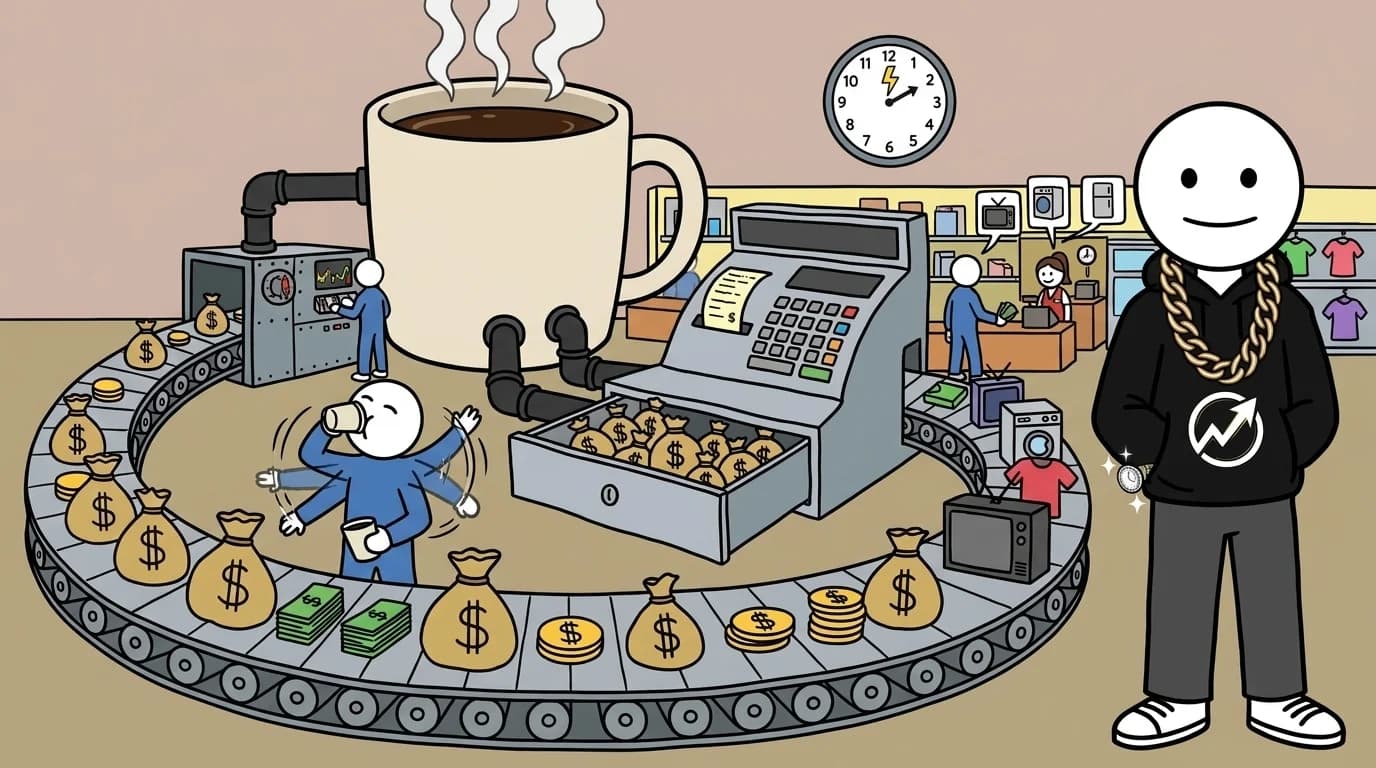
Employers did not invent the coffee break out of empathy for your personal wellness. They introduced it because it is one of the highest-yielding operational investments on a corporate balance sheet. Fifteen minutes they fuel you; two hours you make them rich.
The factory floor experiment that turned caffeine into corporate law
To understand why modern workplaces gladly bankroll your caffeine habit, you have to rewind to the birth of modern scientific management at the turn of the twentieth century. Industrial pioneers like Frederick Winslow Taylor were obsessed with mechanical efficiency. They stood over machinists with stopwatches, measuring every micro-motion of assembly workers to eliminate wasted seconds.
Yet factory managers kept hitting an immovable biological wall: the inevitable 2:00 PM crash. As the afternoon wore on, human workers fatigued. Assembly speeds plunged, mechanical mistakes multiplied, and costly assembly line jams spiked. For corporate owners, an exhausted worker was an inefficient engine.
In 1902, the Barcolo Manufacturing Company in Buffalo, New York, a manufacturer of metal beds and furniture, conducted a landmark workplace experiment. Instead of watching exhausted employees drag through the final hours of the shift, management instituted an official fifteen-minute afternoon pause and supplied complimentary hot coffee to every worker on the floor.
The results revolutionized industrial management. The fifteen-minute interruption did not reduce total daily output; it caused production to skyrocket. The infusion of caffeine and a brief pause eliminated the post-lunch slump, curtailed workplace injuries, and produced two subsequent hours of high-tempo output that far exceeded the cost of the lost quarter-hour.
Decades later, the United States Department of Labor codified this exact commercial principle directly into federal labor law. Under 29 CFR § 785.18, federal regulations mandate that rest periods between 5 and 20 minutes must be counted as paid hours worked because they 'promote the efficiency of the employee.' Meanwhile, under § 785.19, bona fide meal periods of 30 minutes or longer are legally unpaid. The legal distinction is unambiguous: when time feeds your human vitality, you fund it yourself. When time sharpens the employer's tool, they gladly put it on the clock.
The asymmetric return on fifteen minutes of company fuel
When you analyze the financial return on a paid coffee break from the employer's perspective, the numbers reveal why companies never hesitate to fund hot brew stations, fancy espresso machines, and complimentary snack drawers.
- Paid break labor cost (15 min @ $25/hr wage)
- ≈ $6.25
- Unpaid lunch deduction (45 min docked from pay)
- - $18.75
- Net daily payroll offset for employer
- - $12.50
- Surplus afternoon output generated per worker
- ≈ $45.00 - $65.00
- Net return on corporate caffeine investment
- 700% - 1,000%
Companies fund the stimulant that accelerates you, while docking the meal that sustains you.
Consider the real economics. A worker earning $25 per hour costs the business roughly $6.25 for a fifteen-minute paid pause. In return for that tiny investment, the employer prevents a 25% to 35% decline in cognitive speed and physical execution across the final two to three hours of the business day. For knowledge workers and manual operators alike, that sustained focus produces between $45 and $65 in incremental revenue and error prevention.
That is an immediate 700% to 1,000% return on invested payroll. You walk away thinking your employer did you a generous favor, while the company balance sheet quietly captures ten times your break cost in accelerated output.
“A paid coffee break is not human rest. It is preventative maintenance on the employer's most profitable revenue-generating equipment: you.”
Once you recognize this distinction, modern corporate perks become completely transparent. Free cold brew on tap, stocked snack pantries, ergonomic standing desks, and corporate mindfulness apps are rarely designed for your long-term independence. They are operational lubricants engineered to keep you performing at peak capacity until 5:00 PM.
True human rest restores your personal sovereignty, your physical health, and your mental presence for your own life and family. Corporate refueling merely delays your exhaustion until your shift concludes, ensuring you hand over your sharpest hours to the company and return home with an empty tank.
How to reclaim your energy and build personal runway
The objective is not to stop drinking coffee or engage in petty arguments with your office manager. The objective is to stop mistaking corporate refueling for genuine life recovery, and start protecting your highest-leverage energy for your own balance sheet.
- Stop confusing machine maintenance with real rest. A 15-minute caffeine rush in an office kitchen does not replenish your health. Prioritize real physical recovery: uninterrupted sleep, nutritious meals away from screens, and mental decompression that belongs exclusively to you.
- Protect your peak cognitive bandwidth for your own assets. If you give 100% of your sharpest mental focus to your employer from 9 to 5, you will have nothing left for your personal investments or family at 6 PM. Fulfill your professional duties with excellence, but do not redline your engine for a fixed salary.
- Invest your 5 to 9 PM into scalable runway. The ultimate defense against industrial time traps is financial runway. Use your evenings to build skills, acquire cash-flowing assets, and construct an emergency cushion so you never negotiate your life from a position of economic desperation.
- Audit what fuels you versus what burns you out. If you require three cups of coffee just to survive the afternoon, your lifestyle is signaling an unsustainable deficit. Re-evaluate your baseline rest, establish firm end-of-day boundaries, and stop borrowing energy from tomorrow to finance someone else's today.
The end
Found this useful? The fastest way to support the page is to share the reel with one person who needs it.
The Sunday Money Note
1 mindset shift and 3 actions to take that week, in your inbox every Sunday morning. A 5-minute read that starts your week with clarity instead of the Monday dread.