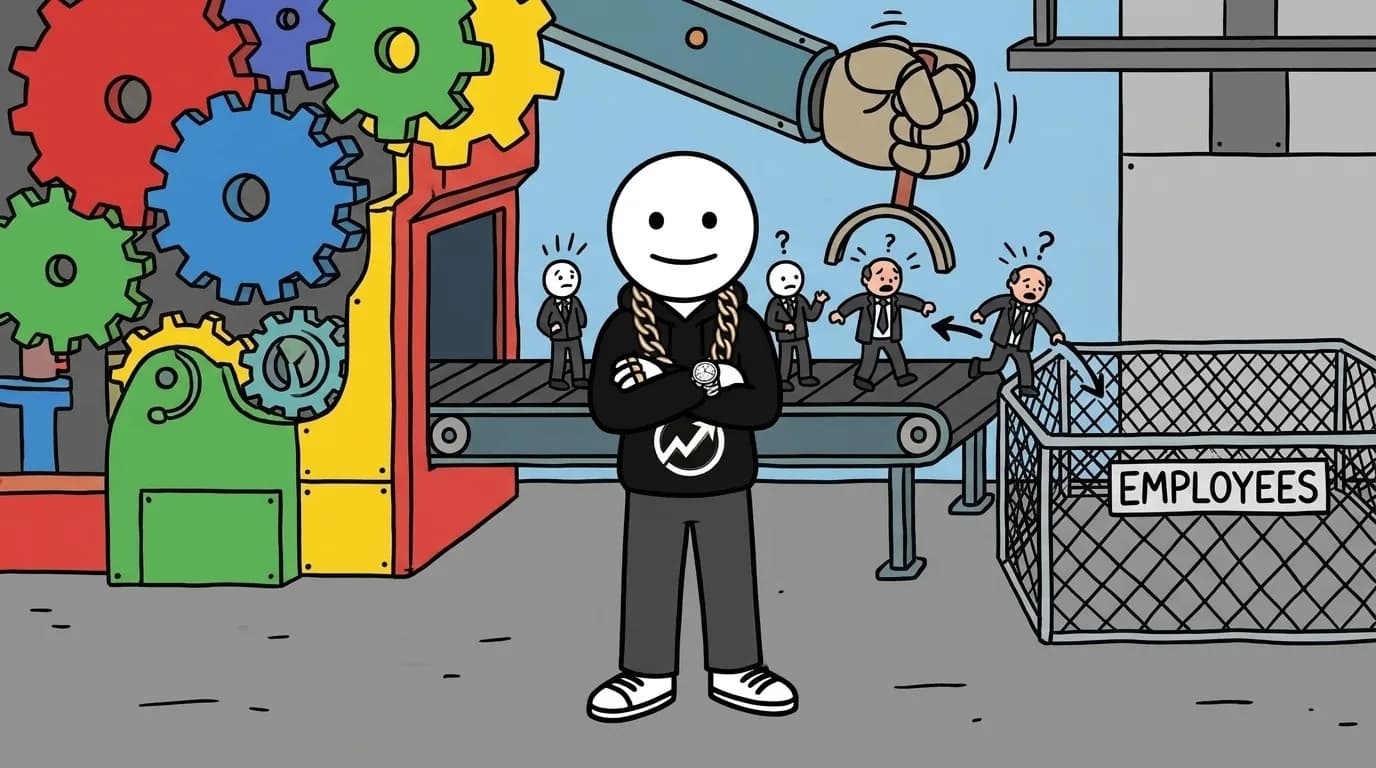
Why Companies Stopped Paying for Your Retirement
For decades, a company pension guaranteed you a monthly paycheck for life. Then corporations pulled off the greatest risk transfer in financial history.

- Traditional pensions placed 100% of longevity, inflation, and market risk directly on the employer.
- The 401(k) was never designed as a national retirement plan; it originated as an obscure tax loophole in 1978.
- By replacing pensions with defined contributions, corporations saved trillions and shifted all market risk onto worker paychecks.
- A company match is a floor, not a ceiling. True financial security requires building income-producing assets you control.
For generations, the social contract between employer and worker was simple. You gave a company thirty years of loyal labor, and in return, the company promised you a guaranteed monthly paycheck for the rest of your life.
It was called a defined-benefit pension. You did not have to become a day trader. You did not have to study candlestick charts, monitor asset allocations, or worry about whether the stock market crashed the week before you retired. Your employer funded the pool, bore the investment risk, and paid you every month until the day you died.
Today, that contract has almost entirely vanished in the private sector. Instead, your employer offers a 401(k), matches a modest percentage, and leaves you to figure out the rest. Most people view their 401(k) as a thoughtful corporate benefit. In reality, it was the single greatest financial risk transfer in modern corporate history.
The accidental tax loophole that changed everything
To understand how we got here, you have to look at the 1970s. Running a guaranteed pension plan was extraordinarily expensive for companies. If the stock market slumped or employees lived longer than actuaries predicted, the corporation was legally on the hook to cover the deficit.
Then came the Revenue Act of 1978. Tucked quietly inside was Section 401(k), a minor tax provision intended to allow corporate executives to defer taxes on year-end cash bonuses. It was never intended to replace the American retirement system.
In 1980, a benefits consultant named Ted Benna realized the language could be applied to everyday salary deductions. When corporate leaders saw what Benna built, a lightbulb went off in executive suites across the globe. By replacing guaranteed pensions with 401(k) plans, companies could eliminate their massive, open-ended retirement obligations overnight.
“Your boss did not offer you a 401(k) to make you wealthy. They offered it to remove your retirement from their balance sheet.”
The brutal math behind corporate savings
When corporations transitioned from defined-benefit pensions to defined-contribution accounts, they pulled off an astonishing accounting victory. Look at how the numbers stack up for a typical career:
- Pension obligation (60% salary over 20 yrs)
- ≈ $840,000
- 3% 401(k) company match (30 yrs total)
- ≈ $63,000
- Direct corporate liability savings
- ≈ $777,000
- Market volatility risk shifted to worker
- 100%
Calculated on a $70,000 annual baseline. The corporation frees up hundreds of thousands in capital while passing all investment volatility directly to you.
Under the pension model, if the stock market crashed 40%, your company still had to pay your monthly retirement check. Under the 401(k) model, if the market crashes 40% on the eve of your retirement, your nest egg is cut in half and your retirement date gets pushed back a decade.
Companies kept the billions in cash flow they once spent funding pensions. Meanwhile, everyday workers got handed the steering wheel, told to pick from twenty confusing mutual funds, and billed for the privilege through administrative fees.
Why loyalty to a corporate plan will not save you
The lesson here is not to abandon your 401(k). If your employer offers a match, taking it is a guaranteed immediate return that you should capture. But you must never mistake a corporate retirement account for genuine financial independence.
Corporations operate under a fiduciary duty to maximize shareholder value, not employee golden years. The moment a business benefit becomes too costly, leadership will alter or eliminate it. Relying entirely on a single employer's contribution formula or the mood of the stock market at age sixty-five is a fragile strategy.
Four steps to take back your retirement security
- Capture the employer match, then stop. Treat the company match as free money and a baseline floor, but never view it as your entire financial plan.
- Audit your internal fund fees. Inspect your plan holdings for high expense ratios. Switch from expensive actively managed target-date funds to low-cost broad index funds that cost less than 0.10% annually.
- Build cash-flowing assets outside Wall Street. Shift your focus toward building assets that put money in your pocket regardless of market swings: cash flow real estate, digital assets, or an independent side business.
- Build a liquid multi-year runway. Avoid sequence-of-returns catastrophe by holding enough cash and liquid reserves so you never have to sell depressed equities to pay basic living expenses.
The end
Found this useful? The fastest way to support the page is to share the reel with one person who needs it.
The Sunday Money Note
1 mindset shift and 3 actions to take that week, in your inbox every Sunday morning. A 5-minute read that starts your week with clarity instead of the Monday dread.