Why Banks Rebranded Debt as Credit
Carrying debt used to be seen as dangerous and shameful. In the 1950s, Wall Street spent millions to rebrand borrowing as an elite status symbol.
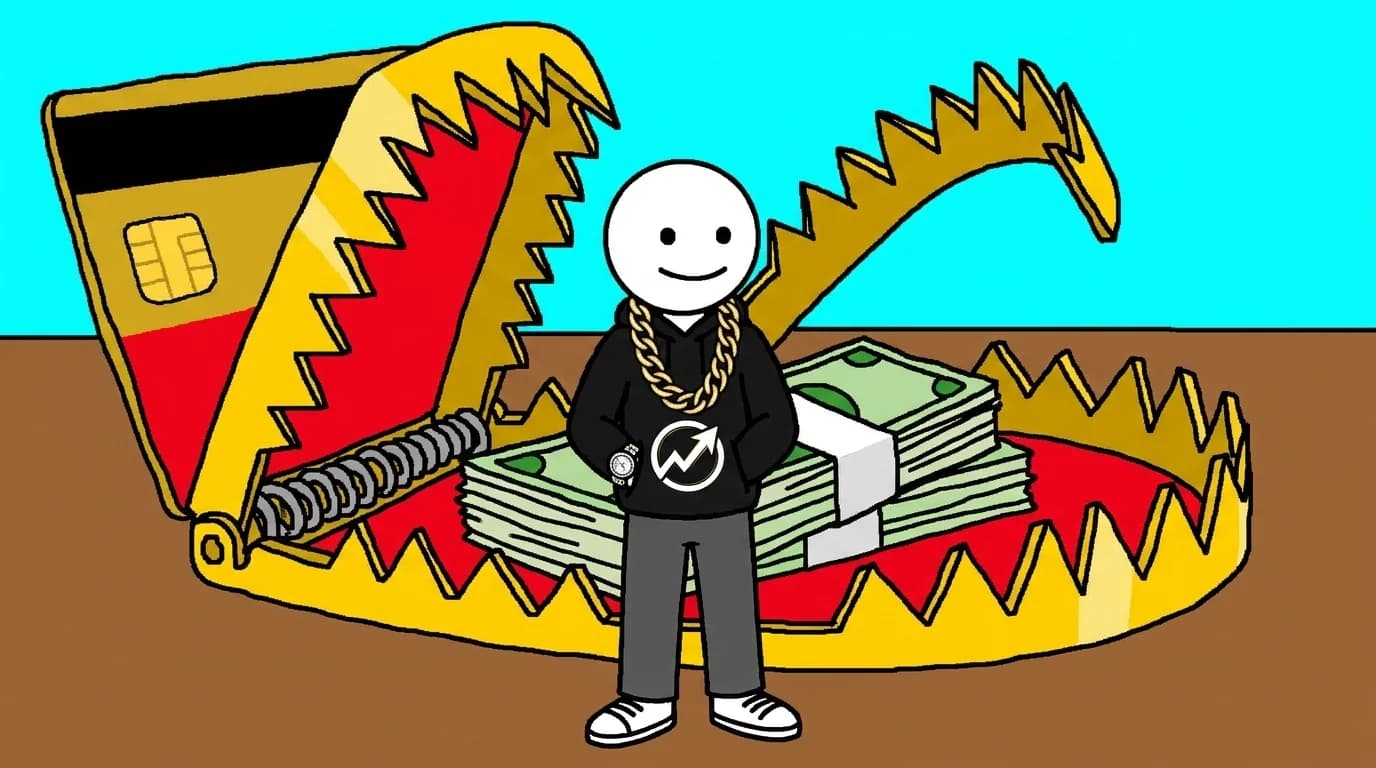
- For generations, carrying unpaid debt was recognized as a serious financial hazard.
- In the 1950s, financial institutions intentionally substituted the word debt with credit to evoke trust and social prestige.
- A high credit limit is not a reward or prize. It is a pre-approved ceiling on how much future income you can pledge to the bank.
- Consumer credit creates an illusion of wealth while transferring compound interest from your pocket to bank balance sheets.
- True independence means buying assets with cash and owning your time instead of financing a lifestyle on borrowed terms.
Watch what happens when someone opens their wallet at dinner. They pull out a heavy, matte-black metal card, tap it on the terminal with a satisfied grin, and mention casually that the bank just bumped their limit to twenty-five thousand dollars. At some point over the last few decades, getting approved to borrow money became a badge of honor.
If you walked up to your great-grandparents in 1930 and bragged that you owed twenty-five thousand dollars to a moneylender, they would not have congratulated you. They would have looked at you with deep concern. Debt was once recognized for what it truly was: an urgent claim against your future labor. So how did the most dangerous financial trap in human history get rebranded into a luxury perk?
The Madison Avenue linguistic rebrand
Before the 1950s, banks faced a massive structural problem: ordinary working families were fiercely allergic to borrowing. The memory of the Great Depression was fresh, and cultural wisdom dictated a simple rule: save cash first, purchase second. If you could not pay for a sofa or refrigerator in cash, you simply walked home empty-handed.
For commercial banks sitting on mountains of post-war capital, this conservative mindset was a nightmare. When households save cash and avoid interest, bank profits remain flat. To unlock exponential revenue, lenders needed everyday citizens to borrow continuously.
The solution was psychological. Financial institutions partnered with advertising agencies to systematically purge the English language of uncomfortable words. The word debt sounded heavy, punitive, and dangerous. In its place, they installed the Latin word credit, derived from *credere*, which literally means *to believe* or *to trust*.
Overnight, borrowers were transformed into cardholders. Owing money was no longer called a liability; it was called a revolving line. Instead of begging a banker for an advance, you were granted a prestigious credit limit that framed reckless borrowing as an earned privilege.
“They did not give you credit. They gave you debt with a better name.”
The Fresno experiment that hooked a nation
In September 1958, Bank of America launched one of the most audacious experiments in financial history, known today as the Fresno Drop. Rather than waiting for customers to apply for loans, the bank mailed sixty thousand unsolicited, pre-activated credit cards directly into the mailboxes of residents in Fresno, California.
It was an unprecedented gamble. By placing pre-approved purchasing power directly into consumers' pockets, the friction of spending money vanished completely. When you hand over physical paper bills, your brain registers the loss instantly. When you swipe a plastic card, that psychological pain disappears, leaving behind only the dopamine hit of the purchase.
The experiment succeeded beyond the bankers' wildest dreams. Delinquencies were high at first, but the interest revenue dwarfed the losses. Within a decade, universal credit cards spread across the globe, fundamentally rewiring how human beings interact with commerce.
The compounding math of the minimum payment
The modern credit card is not designed to help you bridge short-term cash crunches. It is mathematically engineered to keep you on a perpetual payment treadmill. The weapon banks use to achieve this is the minimum payment.
By setting the required monthly payment to roughly two percent of your balance, banks ensure that almost every dollar you submit goes straight toward accrued interest, leaving the underlying principal practically untouched.
- Initial purchase balance
- $5,000
- Average card APR
- 22.5%
- Monthly minimum payment
- ≈ $125
- Time required to reach zero
- 14 years, 2 months
- Total interest handed to the bank
- $6,420
- Total cash extracted from your wallet
- $11,420
Paying only the minimum turns a $5,000 balance into an $11,420 cash extraction. The difference is pure bank profit.
When you finance everyday life on plastic, you are not buying things with bank money. You are leasing your own future hours of labor back to yourself at a twenty percent penalty.
How to break the credit illusion
Escaping the trap does not require cutting up every card and moving into the woods. It requires stripping away the marketing romance and treating debt with the ruthless skepticism it deserves.
- Treat cards like cash cards: Never charge a single dollar that is not already sitting in your liquid checking account ready for transfer that same evening.
- Reject limit increases as status symbols: A twenty-thousand-dollar limit is not a prize. It is a pre-approved ceiling on how much future income the bank hopes you will surrender.
- Stop playing the points game if you carry a balance: Earning two percent in travel rewards while paying twenty-two percent in interest is not smart finance. It is an expensive delusion.
- Measure wealth by assets, not borrowing power: The ultimate flex is not having a high credit score. The ultimate flex is owning cash-flowing assets that make the banking system irrelevant to your daily life.
The end
Found this useful? The fastest way to support the page is to share the reel with one person who needs it.
The Sunday Money Note
1 mindset shift and 3 actions to take that week, in your inbox every Sunday morning. A 5-minute read that starts your week with clarity instead of the Monday dread.